Yuri and I used to play football together. Then I spotted his name among Russia’s war dead

I had no idea he had gone to fight in Ukraine and without hacked data I would probably never have learned of his death
One evening, after weeks spent counting Russia’s war dead, I began looking for names I might recognise.
My colleagues and I had been working our way through more than 11m death certificates leaked from Rosstat, Russia’s state statistics agency, and identifying nearly half a million Russian soldiers who had died in the war in Ukraine.
We had sorted the dead by age, region and cause of death, building the most detailed picture yet of Russia’s losses in nearly five years of war.
Now I typed in the names of the places where I had grown up.
My childhood was spent in Rublevka, a stretch of pine forest west of Moscow that has been home to the Russian elite since Soviet times. With the collapse of communism and Russia’s chaotic embrace of capitalism, the dachas of party officials gave way to the sprawling estates of oligarchs.
Vladimir Putin and Dmitry Medvedev established their residences in Rublevka. In more recent years, the area has become a refuge for ousted leaders, among them Ukraine’s Viktor Yanukovych and, as the Guardian previously reported, Syria’s Bashar al-Assad.
I did not expect to find many names there.
Our analysis had shown just how unevenly the burden of the war had fallen across Russian society. In some of the poorest regions, working-age men were up to 32 times more likely to die in the war than men of the same age in Moscow. I knew sons of the Russian elite who had left the country shortly after the invasion, keen to avoid being called up to fight.
My village, Zhukovka, returned no results.
I worked my way along the Rublyovo-Uspenskoye highway, the well-paved road connecting the wealthy settlements west of Moscow. Here and there, a lone death certificate appeared.
Then I typed in Gorki-10, a town a few miles further down the road, named after the famed writer Maxim Gorky, who spent his final years there.
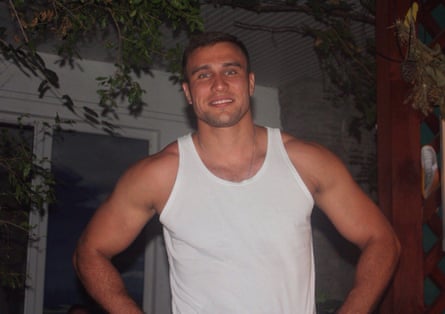
One of the names on my screen was instantly familiar: Yuri Vladimirovich Kyrmyz, aged 31.
Place of death: Makiivka, Svatove district, in the Russian-occupied Luhansk region of Ukraine. Cause of death on 3 February 2025: an explosion during military operations.
Makiivka, a small village on the banks of the Zherebets River, had been the scene of months of bitter fighting as Russian forces sought to retake territory lost during Ukraine’s 2022 counteroffensive.
Two decades earlier, Yuri and I used to play football together as teenagers.
Though we were never particularly close, he was a reliable presence at our games, a quiet, unassuming defender who rarely had much to say. We had not spoken in years. Until that evening, I had no idea he had gone to fight in Ukraine, let alone that he had died there.
I also do not know what made him join Russia’s full-scale invasion of Ukraine.
The Kremlin has worked hard to insulate Moscow and its suburbs from the war. In neighbouring Barvikha, at the Luxury Village shopping complex, visitors can still buy a Ferrari or a Chanel handbag, despite western sanctions. But for all its associations with wealth and power, Rublevka is also home to another Russia.
Parts of Gorki-10 consist of Soviet-era blocks of flats, built for families who serviced the rich or toiled at the local stud farm, which dates back to the 19th century. I remembered that Yuri’s family was not well-off. Before enlisting, Yuri worked as a car dealer.
The signing bonuses and salaries offered by the Russian military, in some cases amounting to several times the average annual wage, would have represented a life-changing sum of money.
Yuri was one of millions of Russians of our generation who grew up immersed in the memory of the Soviet victory over Nazi Germany. Victory Day, on 9 May, was one of the biggest occasions of the year, rivalled only by New Year’s Eve. Over the past two decades, Putin has appropriated that collective memory, telling a new generation of Russians that in Ukraine they are fighting the same “Nazi” enemy their grandfathers once faced.
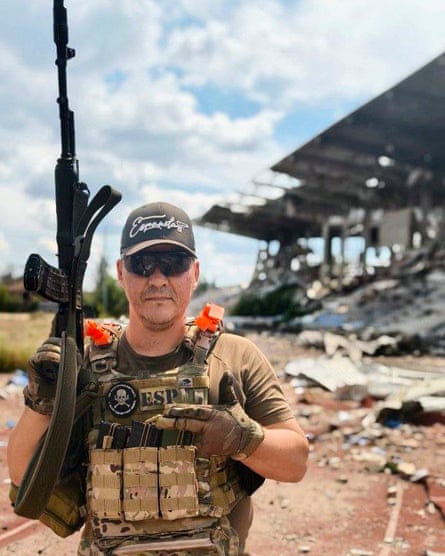
Until I discovered Yuri’s name in the database, the only person I knew to have joined the invasion, other than the soldiers I had interviewed in the course of my reporting, was my former football coach Andrei Solomatin.
In his prime, Solomatin had played for CSKA and Lokomotiv Moscow, won 13 caps for Russia and appeared in all three of the country’s matches at the 2002 World Cup.
But his life unravelled after retirement. There were debts, problems with alcohol and a gradual slide into obscurity. By the time I met him, the former international footballer was eking out a modest living coaching our local Sunday league team.
Our team was an eclectic collection of nationalities, including Dutch (me), British and Nigerian players. I cannot recall Solomatin ever expressing hostility towards Ukraine. Politics, as far as I could tell, did not concern him.
In autumn 2022, he began delivering aid to Española, a far-right military formation drawn from the ranks of Russian football ultras fighting in occupied Ukraine. By July 2023, he had joined the unit himself.
He was back on television, this time in military fatigues. In interviews, he spoke of his “complete trust” in Putin. The war appears to have given him a sense of public importance he had not enjoyed for years.
Yuri, like hundreds of thousands of other Russian soldiers who have died in Ukraine, left little public trace. Had hackers not obtained the records of Russia’s state statistics agency, I would probably never have learned of his death.
Although in some of the worst-affected parts of Russia nearly everyone knows someone who has died in the war, the full scale of the losses remains hidden from the Russian public.
Asked about the military deaths on Wednesday, the Kremlin spokesperson, Dmitry Peskov, dismissed the findings, insisting that only official data could be trusted.
Independent Russian journalists were quick to point out the irony, given that the figures came from the Russian state’s own statistics agency.
Originally from The Guardian. Read the full article at The Guardian →